





Every boardroom today is talking about AI, automation and intelligent decision-making.
But here’s the uncomfortable truth many organisations discover the hard way:
AI does not fail because of models – It fails because of foundations.
In our experience working with enterprise transformation programs, the difference between AI pilots and AI outcomes is rarely the algorithm. It’s the strength — or weakness — of the data architecture beneath it.
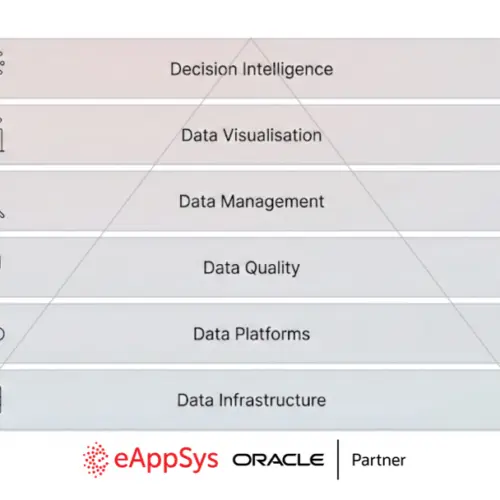
That’s where the Enterprise Data Pyramid becomes a useful lens.
It’s not just a diagram. It’s a way of understanding how data matures from raw inputs to strategic decisions — and why skipping layers leads to fragile, unreliable results.
The Layers That Turn Data into Decisions
Data Infrastructure – The Bedrock
This is where everything begins: Source systems, ingestion pipelines, storage environments and secure access.
If this layer is brittle, AI initiatives struggle to scale. Analytics becomes slow and fragmented. Teams end up spending more time finding data than using it.
Modern enterprises need infrastructure that is:
- Scalable for AI and advanced analytics workloads
- Secure by design
- Cloud-ready and integration-friendly
Without this, every higher layer becomes an uphill battle.
Data Platforms – Structure at Scale
Once data is captured, it needs structure. This is where data lakes, warehouses and modern lakehouse architectures come into play.
This layer ensures:
- Large volumes of data can be stored and processed efficiently
- Structured and unstructured data can coexist
- Different business domains can access what they need without creating silos
A well-designed platform layer is what allows enterprises to move from “data everywhere” to data that can actually be used.
Data Quality – The Foundation of Trust
AI, analytics and reporting all share a common dependency: trustworthy data.
If data is incomplete, inconsistent or outdated, decisions suffer. AI models learn the wrong patterns. Leaders lose confidence in dashboards.
Data quality is not a one-off clean-up. It’s an ongoing capability that includes:
- Validation and testing
- Observability to detect anomalies
- Continuous improvement processes
When this layer is strong, decision-making becomes faster and more confident.
Data Management – Context and Meaning
Having data is not the same as understanding it.
This layer provides:
- Business glossaries
- Data catalogues
- Semantic layers that translate technical data into business language
It’s the bridge between technology and business users. It ensures that when two departments talk about “revenue” or “customer,” they mean the same thing.
Without this layer, organisations don’t have a data problem — they have a language problem.
Data Visualisation – Insight at Speed
This is where numbers become narratives.
Dashboards, reports and self-service BI tools allow business users to:
- Spot trends
- Monitor performance
- Ask new questions without waiting for IT
When done well, visualisation democratises insight. It shifts organisations from reactive reporting to proactive decision-making.
Decision-Making – The True Destination
At the top of the pyramid is not a tool — it’s an outcome.
This is where data drives:
- Better operational decisions
- Smarter resource allocation
- More accurate forecasting
- AI-assisted recommendations and automation
Every layer below exists for this purpose. If decisions aren’t improving, the pyramid has a gap somewhere.
The Side Rails: Governance & Compliance
Running through every layer are governance and compliance.
In today’s environment of tightening regulation and growing scrutiny around AI, governance cannot be an afterthought. It must be embedded from infrastructure to insight.
This includes:
- Data privacy and security controls
- Access management
- Traceability and auditability
- Responsible and explainable AI practices
These “side rails” allow organisations to innovate confidently, knowing they are operating within safe and compliant boundaries.
Why This Pyramid Matters Now
In the rush to adopt AI, many enterprises focus on the top of the pyramid — models, automation, generative tools — while the lower layers remain underdeveloped.
The result? Isolated pilots. Fragile deployments. Low trust.
Enterprises that succeed with AI and digital transformation are the ones that treat data as a layered strategic asset, not just a reporting by-product.
The Enterprise Data Pyramid is a reminder that: Intelligence at scale is built, not plugged in.
The organisations that invest in these foundations today are the ones that will turn AI from experimentation into sustained competitive advantage.