





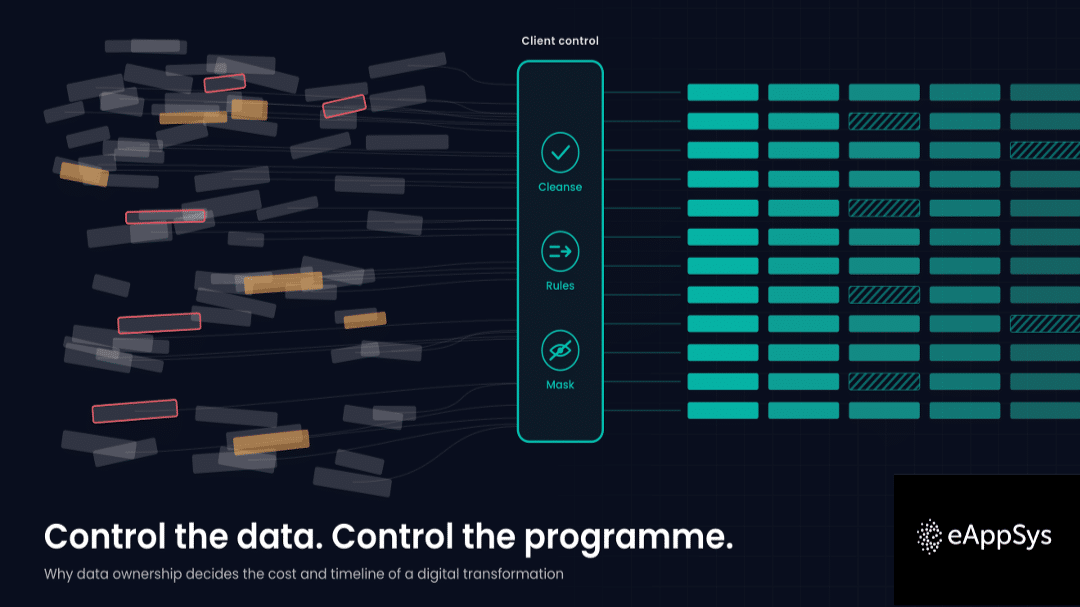
Most cloud transformation programs are planned around the system: the configuration, the integrations, the go-live date. The data is assumed to arrive when needed, in the shape needed. It rarely does, and when it doesn’t, the programme slows down.
The uncomfortable fact is that in almost every implementation contract, the client owns the data. The systems integrator configures the target, builds the migration tooling and runs the loads. But the source data, its quality, and the rules for how it should be transformed sit with the client. That is where the pressure lands.
Where the pressure comes from
Three data workstreams run alongside any Oracle Fusion Cloud implementation, and each one can hold the programme hostage.
Data cleansing. Legacy systems accumulate years of duplicate suppliers, inactive employees still flagged as active, cost centres that no longer exist, and address fields used for notes. None of this can be loaded as-is. Cleansing it is manual, cross-functional work that has to be done by people who understand the business, and those people already have day jobs.
Transformation rules. Every field that moves from the old system to the new one needs a rule: which legacy values map to which new ones, what the default is when the source is blank, how a flat chart of accounts becomes a multi-segment key flexfield. These rules cannot be written by the implementation partner alone. They need decisions from finance, HR, procurement and operations, and those decisions often expose disagreements that have been avoided for years.
Data readiness for AI. This is the newer pressure. Clients now expect AI capabilities from day one — agents, predictive insights, intelligent document processing. Those capabilities are only as good as the data underneath them. Inconsistent master data, missing hierarchies and unstructured fields that were tolerable in a reporting context become blockers when a model has to reason over them.
Each of these has a dependency on the others, and each has a deadline set by the cutover plan. A delay in cleansing pushes back mock conversions. Missing transformation rules stall the build. Data that isn’t fit for AI means the AI scope gets deferred to a later phase, which is usually where it stays.
Why this becomes a programme risk
Data work is under-estimated for a consistent reason: it looks like a task and behaves like a project. The effort is spread across many people, none of whom own it full time. Progress is hard to measure until a mock load fails. And the tooling most clients start with — spreadsheets, ad hoc SQL, email threads — does not scale past the first few thousand records.
The result is predictable. Data becomes the critical path. Testing cycles are consumed by data defects rather than configuration defects. Cutover weekends run long. Go-live is met, but with a backlog of data fixes that carries into hypercare and damages user confidence in the new system.
The cost of this is rarely visible at the point it is incurred. A single late data delivery from the client to the implementation partner — a cleansed supplier file that arrives two weeks after the agreed date, say — does not cost two weeks. It pushes the mock conversion, which pushes the test cycle that depends on it, which pushes the defect fix window, which pushes cutover. The partner’s team is still on the programme and still being paid during each of those slips, and change requests follow. What began as one missed data milestone becomes an extended timeline, an increased implementation fee and, in the worst cases, a deferred go-live with the legacy system’s licence and support costs running in parallel. The client owned the data; the client absorbs the cost.
What good control looks like
Clients who get through this well tend to do the same few things.
They treat data as a workstream with its own plan, its own owner and its own reporting line into the programme board, rather than as a set of tasks scattered across functional teams.
They get their data partner in place before their implementation partner. Duplicate suppliers, stale employee records and inconsistent reference data can be dealt with without knowing anything about the target system, and a data partner engaged three to six months ahead of the main programme can have profiling done, cleansing under way and the first set of transformation rules agreed before the implementation team is mobilised. The implementation partner then scopes and prices against known data, not assumed data. That is the single biggest lever a client has over the overall cost and timeline of the programme, because it removes the largest source of unplanned delay before the expensive part of the project starts.
They make transformation decisions once and record them somewhere the whole programme can see, rather than in the inbox of whoever asked the question.
They control who sees what. Implementation teams are rarely in one place. A typical programme has consultants in the UK, a delivery centre in India, third-party specialists elsewhere, and client staff spread across regional offices. Every one of them needs realistic data to build and test with, but none of them needs live salaries, bank details, national insurance numbers or customer contact data. Once data crosses borders, the client is dealing with international transfer rules under UK GDPR as well as the local data protection regimes in each location. Masking the data before it leaves the client’s control turns that from a legal and contractual problem into a technical one that is solved once.
And they use tooling built for the job. The market now has mature platforms for profiling, deduplication, standardisation and rule-based transformation, and there is little reason to run a multi-entity migration on spreadsheets.
Where DMOne™ fits
DMOne™ is eAppSys’s data migration and management platform, built specifically for Oracle Fusion Cloud programmes. It is designed to take the load off the client’s data team in the areas above.
- Ingestion. Connects to legacy sources and extracts data into a controlled staging area, so cleansing happens in one place rather than across multiple exports.
- Profiling. Shows the actual condition of the data early — completeness, format inconsistencies, orphaned references — so the scale of the cleansing effort is known before it becomes a surprise.
- Deduplication and standardisation. Identifies duplicate records across suppliers, customers, employees and items using configurable matching rules, and standardises formats for addresses, names, codes and dates.
- Transformation rules. Holds the mapping and transformation logic in one maintained repository, applies it consistently across every mock load, and gives the business a place to review and sign off the rules.
- Masking. Working with MaskIQ™, sensitive fields are masked or substituted in the staging area before data is made available to the implementation team. The client decides which data classes are visible — for example, real employee names but masked pay and bank data, or fully synthetic customer records for test environments — and the same rules apply consistently across every environment and every mock load. The client keeps control of the real data throughout, regardless of where the project team sits — a UK-based team, an offshore delivery centre and a third-party integrator all work from the same masked dataset, and the unmasked data never leaves the client’s jurisdiction.
- Load and reconciliation. Generates Oracle-ready file formats, tracks load results and reconciles record counts and control totals back to source.
- AI readiness. Because the platform enforces structure and consistency during migration, the data landing in Fusion is already in a condition that downstream AI capabilities can use, rather than needing a second remediation exercise.
The point is not that a tool removes the client’s responsibility for the data. It doesn’t, and no tool should claim to. The point is that the client’s people spend their time making business decisions about the data instead of manipulating files, and the programme gets a repeatable, auditable process instead of a one-off scramble.
The takeaway
Digital transformation succeeds or fails on whether the organisation can get its data into the new system, correctly, on time, and in a shape that supports what comes next. That responsibility sits with the client, and it is heavier now than it was five years ago because of what AI expects of the data.
The clients who take control of it early — with a data partner engaged ahead of the implementation partner, a dedicated workstream and proper tooling — go live on schedule, at the cost they planned for, and start getting value from the system straight away. The ones who don’t spend the first year after go-live fixing what should have been fixed before it.
Does this resonate enough with you to make you want to discuss your Digital Transformation initiatives? Click Here Book a free Appointment:
eAppSys is a UK-based Oracle Fusion Cloud systems integrator. DMOne™ is part of the eAppSys accelerator suite.