





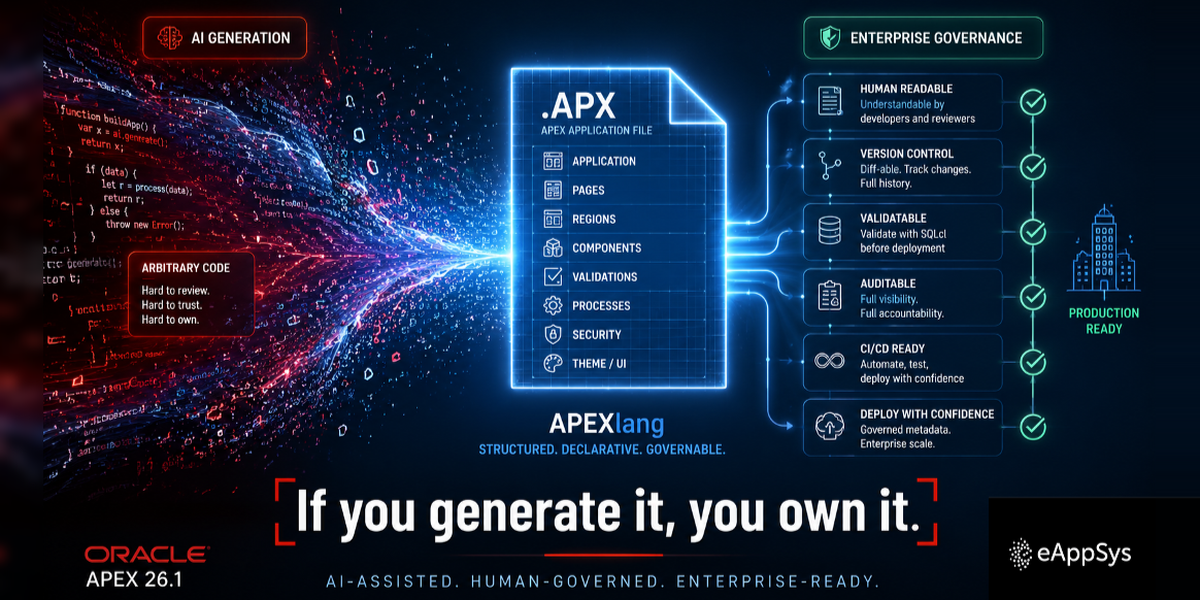
That one line, from Oracle’s APEX 26.1 announcement last week, is the most important thing said about AI in enterprise development this year.
For years, the debate around AI-generated code has been about productivity. How fast can the AI write the app? APEX 26.1 reframes the question entirely. The new bottleneck isn’t generation — it’s trust. Can the enterprise inspect, govern, and own what the AI just produced?
Oracle’s answer is APEXlang.
Instead of generating thousands of lines of arbitrary application code, APEX 26.1 lets AI generate a structured, declarative .apx file — human-readable, version-controllable, diff-able, and validatable through SQLcl before it goes anywhere near production.
The application’s intent is captured as metadata the platform can execute, not as code an enterprise has to forensically review.
Three things land for us at eAppSys when we read it:
- AI in enterprise applications finally has a governance model that doesn’t depend on the developer remembering to check.
- The same .apx file an AI generates is the file a human reviews — there’s no translation layer where trust quietly leaks.
- Audit, source control, and CI/CD just became achievable for AI-assisted APEX development. Not aspirational. Achievable.
We’ve been building APEX applications for enterprise customers for years. AI in that work has been useful, but it has also raised the question every CIO eventually asks: who is accountable for the code we didn’t write?
APEX 26.1 gives us a defensible answer.
If you’re running APEX in production and haven’t looked at 26.1 yet, it’s worth thirty minutes this week. We’re happy to walk through what it changes for your team.